 Opals
Opals
 Gemstones
 Jewelry
 Coins
Coins


You have not bid on this auction.
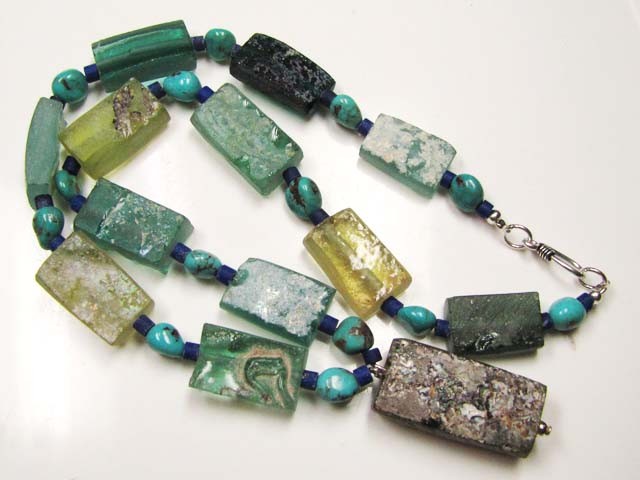
ANCIENT ROMAN GLASS NECKLACE 289 CARATS GTT 1552
- SKU
- Dimensions (mm)
- x x mm
- Weight (g)
- Colours
-
ANCIENT ROMAN GLASS
This is a stunning glass bead specimen which is between 700 to 3000 years old.Thousands of years ago, the Romans came to Afghanistan to trade glass and teach the art of glass making. Buried for centuries, the discarded chunks had been thrown into a pit for recycling, a common practice in ancient times, but instead were forgotten.It was just recently re found.This piece we selected for its stunning colour-ideal as a centre piece in a necklace or kept a as a specimen.It should not be used where there is excessive rubbing.
Drilled
Weight 289 cts app
Size FOCAL GLASS BEAD 30X 15X 10 MM
NECKLACE ANCIENT GLASS AND TURQUOISE AND LAPIS BEADS 46 CM LENGTH
COLOUR-where does it come from.?
The brillant colours come from a chemical reaction from the glass when left in the soil for ions.We have a similar result in the opal fields in Lightning ridge Australia as when a bottle is left for years there are some faint opal like colours appear-but it is nothing compared to the brillant colours from this ancient glass.The sands used to manufacture ancient glass contained manganese and iron ore impurities which over centuries gives unique colours to the glass when left in the ground. The sands also contained sulphurs and glass blowers added minerals to colour enhance these glass vessels.They added red by mixing copper, and lead.
| Shipping provider | Shipping to Australia | Shipping to rest of world | Combined Shipping (Australia) | Combined Shipping (rest of the world) |
|---|---|---|---|---|
| FedEx |
|
|
|
|
| Registered Shipping |
|
|
|
|
- SKU
- Dimensions (mm)
- x x mm
- Weight (g)
- Colours
-
ANCIENT ROMAN GLASS
This is a stunning glass bead specimen which is between 700 to 3000 years old.Thousands of years ago, the Romans came to Afghanistan to trade glass and teach the art of glass making. Buried for centuries, the discarded chunks had been thrown into a pit for recycling, a common practice in ancient times, but instead were forgotten.It was just recently re found.This piece we selected for its stunning colour-ideal as a centre piece in a necklace or kept a as a specimen.It should not be used where there is excessive rubbing.
Drilled
Weight 289 cts app
Size FOCAL GLASS BEAD 30X 15X 10 MM
NECKLACE ANCIENT GLASS AND TURQUOISE AND LAPIS BEADS 46 CM LENGTH
COLOUR-where does it come from.?
The brillant colours come from a chemical reaction from the glass when left in the soil for ions.We have a similar result in the opal fields in Lightning ridge Australia as when a bottle is left for years there are some faint opal like colours appear-but it is nothing compared to the brillant colours from this ancient glass.The sands used to manufacture ancient glass contained manganese and iron ore impurities which over centuries gives unique colours to the glass when left in the ground. The sands also contained sulphurs and glass blowers added minerals to colour enhance these glass vessels.They added red by mixing copper, and lead.
| Shipping provider | Shipping to Australia | Shipping to rest of world | Combined Shipping (Australia) | Combined Shipping (rest of the world) |
|---|---|---|---|---|
| FedEx |
|
|
|
|
| Registered Shipping |
|
|
|
|

Gem Traders has an established market in Australia for gemstones and we added Opals to compliment th....
-
 Positive
Paid and shipped - no feedback left after 60 days

-
Positive
Pendant is more beautiful than pics Gem Traders is always reliable and sells jewelry for a fair price

-
Positive
Gorgeous ring for the price, very unique design, the pearls are perfect.


Why are users outbidding themselves?
When a bid is placed, this is the maximum amount a person is willing to bid for the product. Our system will then automatically bid on behalf of the bidder, incrementally increasing the bid up to the maximum to maintain their position as the highest bidder.
When there is an icon indicating 'Automatic Bid', it means our system is actively placing bids for the bidder based on their maximum bid. This may appear as if bidders are outbidding themselves, but it's simply a result of the system updating the bid to reflect the bidders maximum limit.
